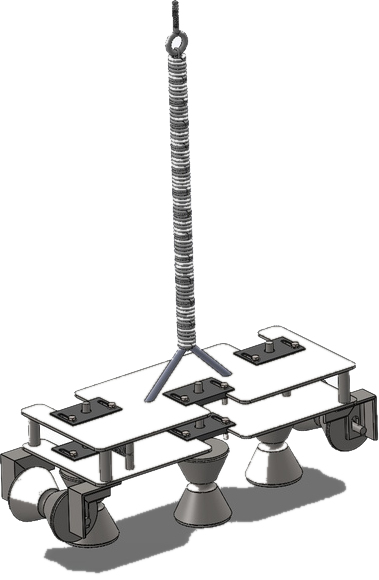
The problem, and what changesThe full rope of the scraper winch is not suspended in any way — it drags on the ground and wears out. A worn rope breaks at least once per shift, and repairing it takes roughly 40 minutes during the mine's most critical production window. The Snatchblock suspends both the full and the empty rope in the air without infringing on the scraper, so the rope lasts five to ten times longer and breaks far less often.
Underground application- Along the full scraper rope run in the gulley
- Conventional stoping
- Anywhere the full rope currently drags on the footwall
- Gullies where rope replacement and splicing recur
Development statusDesigned in 2025 — not yet trialled underground. The polymer unit is in manufacture against a signed-off general assembly. We are looking for one gulley, on one shaft, to run it against the mine's own rope and splice figures — and we will publish what it does, whichever way it goes.
Specifications- Scraper attachments
- Required — sold in sets of two
- Rigging
- Doubled-up rigging built into the unit — the suspension carries a second, independent point, so exposure in the death triangle is reduced rather than transferred to the crew
- Mass
- 150 kg for the original steel unit; the polymer unit targets 80 kg
- Load capacity
- 74 t for the steel unit at a 185% safety factor; 45 t at 112% for the lighter unit
- Assembled dimensions
- 1 300 mm × 850 mm frame; rollers on 400 mm centres
- Suspension
- Sprung, with 50 mm travel on Ø50 mm ID tension springs. A chain is fitted with slack as an emergency restraint; the spring is the primary support.
- Rope
- Ø19 mm scraper rope. A 100 mm elevating snatchblock for the empty rope is included with each unit.
- Patent
- ZA provisional 2026/02710 — Dual Elevating Snatchblock
 Snatch Mining Industries